

 LinkedIn
Delivering full-service Answer Engine Optimization across 10 client domains costs $27,250 to $51,550 a month in this model. That is $2,725 to $5,155 per domain. The tracking license is the smallest line on the sheet; writer hours, developer tickets, citation outreach, and reporting time are where the retainer margin dies.
I understand why the license gets all the attention. Its price is right there on the vendor page. The rest of the work arrives as a series of small requests that look manageable until ten clients need them at once.
| Recurring delivery line item | Monthly volume across 10 domains | Monthly cost | Cost per domain | Figure source |
|---|---|---|---|---|
| Tracking and prompt software | 50–100 tracked prompts per domain across four AI engines | $1,200–$2,500 | $120–$250 | Otterly vs. Profound pricing |
| Citable content production | Four structured articles per domain; 40 total | $15,000–$27,000 | $1,500–$2,700 | Wisdom Writes content benchmarks |
| Technical development and schema | Three to six hours per domain | $2,550–$6,300 | $255–$630 | Web developer rate benchmarks |
| CMS staging and formatting | 30–60 minutes per article; 40 total | $1,000–$2,000 | $100–$200 | Promarkia on agency publishing work |
| Authority citations and PR | Two third-party citations per domain; 20 total | $6,000–$10,000 | $600–$1,000 | Reporter Outreach link pricing |
| Account management and reports | Three to five hours per client | $1,500–$3,750 | $150–$375 | Mintec on agency reporting |
| Total direct monthly delivery | Full modeled scope across 10 domains | $27,250–$51,550 | $2,725–$5,155 | Sum of the lines above |
Those are recurring delivery costs, not setup costs or every dollar an agency spends to run its business. The ranges are a planning model, not a quote for any particular client book. At their paired low and high ends, tracking accounts for roughly 4–5% of the monthly total. The work after the dashboard accounts for the rest.
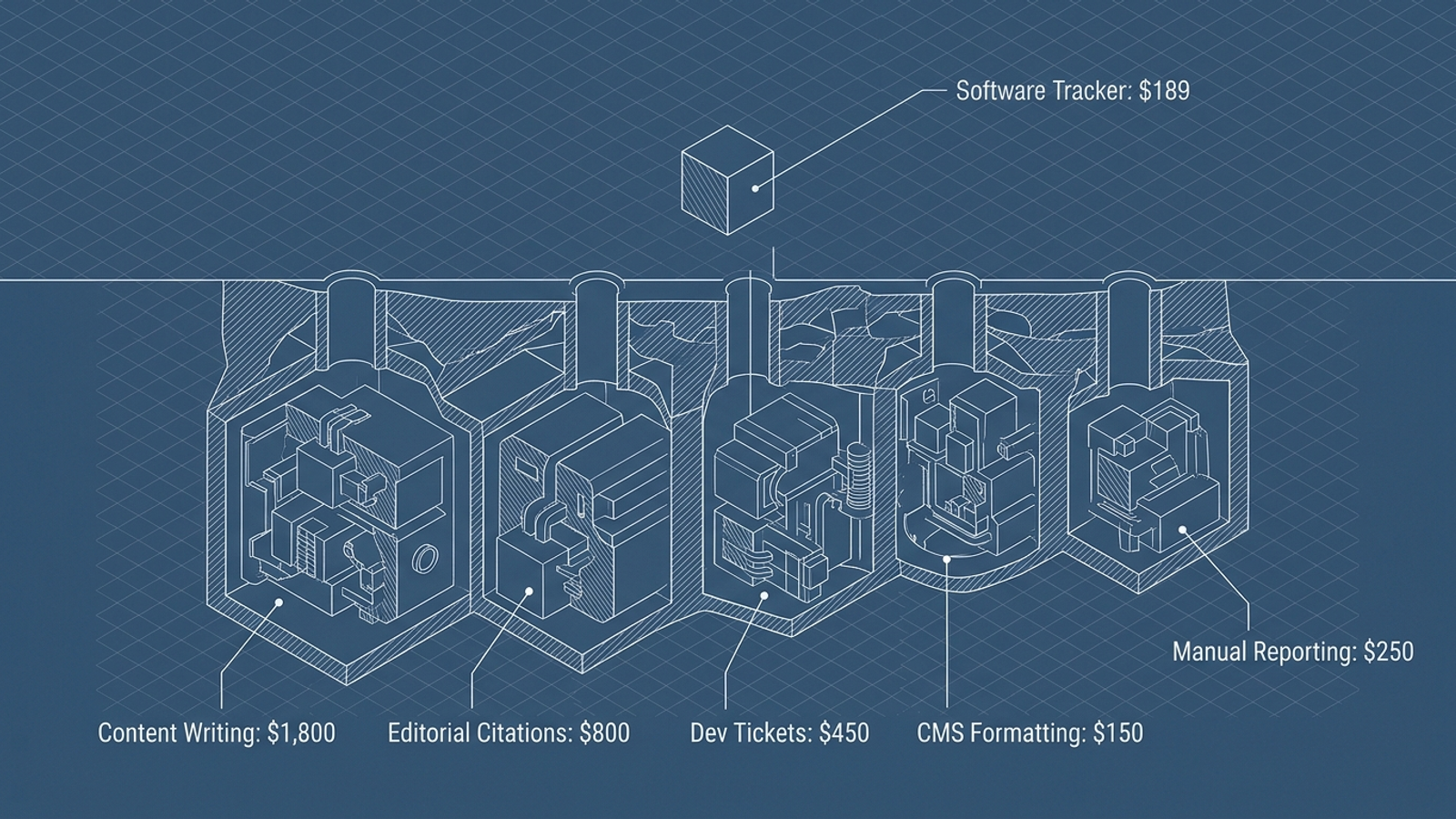
Ran Yosef, founder of Arobis AI, makes a similar point in his AEO service cost breakdown: in his example $2,500 retainer, tracking software takes $189 and human labor takes $2,311. Pricing delivery from a dashboard subscription is like buying a wrench and assuming the factory builds itself.
The scope behind the numbers
This model assumes 10 active client domains, each paying $2,500 to $4,000 a month for full-service organic and AI search visibility. Each month, the agency aims to deliver:
- Four citable, structured informational articles per domain.
- Technical upkeep for crawler access, page structure, and schema where needed.
- Two authoritative third-party citations per domain.
- Weekly tracking across 50–100 prompts per brand and four AI engines.
- Reporting, status updates, and client communication.
Clients paying for that scope expect more than a screenshot showing whether their name appeared in ChatGPT, Perplexity, Claude, or Google AI Overviews. They expect the agency to respond when visibility changes. That expectation is what turns a software purchase into a delivery operation.
Line 1: prompt tracking buys a signal, not a fix
Entry tiers make monitoring look cheap. Otterly.AI advertises a $29 monthly Lite tier for 15 prompts and a $189 standard tier for 100 prompts, with Gemini and Google AI Mode as paid add-ons. Profound lists $99 a month for ChatGPT monitoring, $399 for its three-engine Growth tier, and $499-plus custom enterprise pricing at greater scale. As seoClarity notes in its Peec AI pricing analysis, Peec’s self-serve tiers start at $95 for 50 prompts on one project and cap projects and prompts before custom pricing enters the conversation.
Across 10 domains, 50–100 prompts each means 500–1,000 prompts to track across four engines. The model budgets $1,200–$2,500 a month for that monitoring. The bill depends on prompt limits, engine coverage, projects, and add-ons, not the cheapest tier a vendor puts above the fold.
More important, a monitoring tool reports the problem. It does not fix a crawler block, publish an article, or earn a mention. I made that distinction in my look at AEO software for agencies at client number ten. Do not price execution from a monitoring plan.

Line 2: forty citable articles consume the content budget
Content is the first large expense: $15,000–$27,000 a month for four articles on each of 10 domains. The model uses 40 researched, structured pieces rather than 40 lightly reworded posts. Writers need to make the useful answer easy to find, support the claims a client wants to make, and shape the page so a reader can use it too.
At the draft’s $0.25–$0.45 per-word rate, a 1,500-word asset costs $375–$675. Multiply by 40 and you reach the table’s range before treating a raw LLM draft as finished work. Those drafts still need practitioner review, code checks where relevant, and editorial verification; the model allows 30–45 minutes of review per piece.
A $2,500 retainer across 10 clients brings in $25,000. At this modeled scope, content alone can consume more than half of it. Cheap generation does not make review, accuracy, or publishing disappear.
Line 3: developer tickets turn small fixes into a queue
The technical line budgets three to six developer hours per domain per month. At the cited $85–$105 median hourly range from What Should I Charge, that is $2,550–$6,300 across the book.
The tickets vary by site. A team may need to investigate crawler access, correct a robots.txt rule, fix structured data that does not match the page, or deal with content an engine cannot readily retrieve. JSON-LD and an llms.txt file may be part of the work, but neither is a magic requirement that makes a site appear in an answer.
The cash cost is only half the irritation. When a fix needs client IT approval, a short task can sit for weeks. The agency still owns the status update and the disappointed client call. Budget for the ticket and the wait.
Line 4: publishing forty posts is still forty publishing jobs
I call this the copy-paste tax. Ten clients rarely have ten identical CMS setups. One has a custom WordPress theme; another has a headless build; another locks down Shopify access. Every approved article still needs headers, links, metadata, layout checks, and a final look after it goes live.
Promarkia’s discussion of automated WordPress posting for agencies puts manual staging and formatting at 30–60 minutes per post. For 40 posts, that is 20–40 hours. This model prices the coordinator work at $1,000–$2,000 monthly.
That is not the glamorous part of an AEO pitch. It is still part of delivery. A finished draft is not a published page.
Line 5: authority outreach is a separate production line
The model calls for two third-party citations per domain per month: 20 placements across the client book. That is outreach and editorial work, not another setting in the tracking tool.
Reporter Outreach’s link-pricing discussion cites an average of $508.95 for a genuine editorial citation, with placement costs varying by publication and approach. This model budgets $6,000–$10,000 monthly for 20. The exact bill depends on the opportunities available, the quality of the placements, and how much outreach the team must do to earn them.
External mentions can help establish a client’s presence beyond its own site. They do not guarantee that an answer engine will cite the client on a particular prompt. Sell the outreach work; do not sell a guaranteed citation in an AI answer.
Line 6: reporting takes time even when the charts exist
AEO reporting rarely comes from one tidy export. An account manager pulls tracking data, checks live answers, captures examples, and explains why a brand appeared for a prompt one week but not the next. The client wants to know what changed and what the team will do about it. Fair question.
Mintec’s agency reporting discussion informs the model’s three to five hours per client each month for reports and status syncs. Across 10 accounts, that is 30–50 hours. At the modeled loaded cost of $50–$75 an hour, the line comes to $1,500–$3,750 monthly.
Call those hours account management, reporting, or Friday disappearing into screenshots. If a person does the work, it belongs in the cost sheet.
Costs outside the monthly table: setup, delays, and rework
The six lines above describe recurring delivery. Three other costs need their own place because treating them as a software overage hides what causes them.
- One-off onboarding: $500–$1,000 per domain. Initial access checks, entity and citation-gap reviews, and prompt setup add $5,000–$10,000 across 10 domains in this model. That is separate from the monthly total. If the agency does not charge a setup fee, it must recover the cost elsewhere.
- Client approval delays: variable. Product, pricing, and technical claims may sit with legal or marketing reviewers. The number of rounds and the people involved drive the cost; I would not invent a flat monthly figure for it.
- Engine-change rework: variable. When answers change, someone has to inspect the affected prompts and decide whether a page, citation, or technical issue needs attention. The work may displace planned tasks even when there is no extra client billing.
A vendor can put a number on a prompt pack. It cannot put a universal number on a client’s approval queue. Keep the known setup cost separate, and leave capacity for the variable work.
The margin left at three retainer prices
Now put the $27,250–$51,550 monthly delivery range against three prices for the same 10-domain book. These are gross margins after the modeled direct delivery costs, before the separate onboarding cost and other agency overhead.
| Monthly retainer per domain | Revenue from 10 domains | Direct monthly delivery cost | Monthly gross profit or loss | Gross margin range |
|---|---|---|---|---|
| $2,500 | $25,000 | $27,250–$51,550 | -$2,250 to -$26,550 | -9% to -106% |
| $3,500 | $35,000 | $27,250–$51,550 | +$7,750 to -$16,550 | +22% to -47% |
| $5,000 | $50,000 | $27,250–$51,550 | +$22,750 to -$1,550 | +45% to -3% |
At $2,500, this full-service scope loses money even at the low-cost end. At $3,500, it can earn a margin, but the high-cost end still produces a serious loss. At $5,000, the low-cost case looks healthier; the high-cost case does not.
That is why I would settle scope before promising a margin. The retainer price alone tells you almost nothing until you price the work behind it.
The flat per-domain alternative on the same sheet
A flat per-domain platform changes the calculation more than a discount on prompts. groas for agencies lists full-service organic search and AEO delivery at $999 per client domain per month. For 10 domains, the platform line is $9,990 a month instead of separate contracts for the modeled tracking, writing, development, publishing, authority, and reporting stack.
The distinction is execution. The described service handles structured JSON-LD, llms.txt and crawler directives, content publishing to client CMSs, third-party entity authority work, and live prompt tracking. A human strategist oversees guardrails, and agencies receive white-label weekly reporting. That is the operating-model shift I discussed in white-label SEO versus white-label AEO.
Here is the arithmetic if the platform fee replaces the six modeled direct-delivery lines:
| Monthly retainer per domain | Revenue from 10 domains | groas platform cost | Revenue less platform cost | Margin on those figures |
|---|---|---|---|---|
| $2,500 | $25,000 | $9,990 | $15,010 | 60% |
| $3,500 | $35,000 | $9,990 | $25,010 | 71% |
| $5,000 | $50,000 | $9,990 | $40,010 | 80% |
Those figures are revenue less the platform fee, not a promise that an agency has no other costs. Client-specific approvals, the agency’s own relationship management, and any work outside the platform’s scope still need a home in the budget. The point is narrower and more useful: replacing fragmented execution changes the largest lines, while shaving a few dollars off a prompt price changes the smallest one.
Who should still build their own stack
I can see the case for an enterprise brand with one proprietary site, an internal development team, custom API pipelines, and a reason to run manual retrieval experiments. It already has people and infrastructure close to the work.
An agency juggling client domains across WordPress, Webflow, Shopify, and custom builds faces a different bill. Every tool needs an owner. Every handoff needs a person. Every delayed ticket lands back on the account team while the retainer stays fixed. If you build the stack, price the general-contractor work too.
The cheapest mistake and the most expensive one
The cheapest mistake is buying a $189 tracking plan and expecting account managers to deliver AEO in their spare time. You lose the subscription cost and some time before discovering that a visibility chart does not write code, publish content, or earn citations.
The most expensive mistake is selling 10 clients a full-service scope at $2,500 per domain without costing its delivery. In this model, that creates a $2,250–$26,550 monthly loss before one-off onboarding and other agency overhead. Ten retainers can look like a healthy book of business right up to the moment you add the lines underneath them. Price execution, not the license.