

 LinkedIn
Subject: Your March AI Visibility Insights Are Here
Hi Sarah,
Great news. We found 847 content gaps this month and closed zero of them. That is up from 812 gaps in February, while your citations remain at 0. Your gap pipeline is growing without disturbing your visibility trend.
Our engine ran 1,200 prompt checks across six engines and prepared everything you need to understand the work ahead. Below are your highlights, your assigned next steps, and a new score that gives your executive team something more encouraging to look at than citations. We did the finding. The fixing part is all yours.
Your dashboard highlights: more gaps, steady citations
847 content gaps detected, up from 812. We ran your buyer prompts across ChatGPT, Perplexity, Gemini, Claude, and two other engines, compared the answers with your site, and logged the questions for which you were not cited. That is the essential tracking job: run the prompts and record the mentions. No page was rewritten, no review was earned, and no crawler was unblocked. Those activities would have changed the thing we are measuring, which belongs in a different column.
The new gaps are particularly useful because they are new to the report. Some may have been sitting on your site all along; our dashboard did not know about them yet. Discovery still counts as progress in the discovery column. If your team would like progress in the citation column, it can use the discovery column to begin work there.
Citations this month: 0, stable. You appeared in 0 of the 1,200 tested answers, just as you did in February. I know 0 looks low when you put it beside 847. Fortunately, Seer has explained why AI visibility alone can be a vanity metric: answers vary by prompt and person, platforms do not report prompt volume, and many real B2B prompts already include a brand name. We encourage you to remember those limitations when assessing the zero. We encourage you to set them aside when assessing the 847.
Your competitors appeared often enough for us to identify 148 blog posts where ChatGPT quoted one instead of you. This gave us another useful insight: when the answer names a competitor, it does not name your business. We have preserved the examples in the dashboard so your team can open them, study them, and decide who has time to change that.
Introducing the Visibility Momentum Index
You told us that 0 citations for two months felt flat. Product listened. Your new headline KPI is the Visibility Momentum Index: 78.4, up 6.2 points. It blends gap volume, prompt coverage, and sentiment into a number that improves when we monitor more prompts. Your citations are still 0. The Index is not.
HubSpot describes the problem with visibility numbers stripped of comparison and conversion data: 40% visibility can look fine until a competitor has 80%, while 100 AI sessions reveal little without knowing whether they converted. Our executive summary avoids both sources of discomfort. It does not put your score beside a competitor’s, and it does not ask what the traffic did after arriving.
How is 78.4 calculated? We weight prompts monitored, gaps found, and reports opened. Citations receive a weight of 0%. That keeps the Index responsive to our activity while your presence in ChatGPT and Perplexity remains unchanged. If someone asks whether 78.4 is good, the arrow beside it points up. Please include the arrow when sharing the slide.
Your next steps: assigned to your team
Thank you for trusting us with detection. Closure is a client-side activity. We have assigned your 847 gaps to your team with due dates before the April pulse check. The largest groups are 212 thin service pages to rewrite, 148 blog posts to strengthen, and 96 technical flags to fix. We also recommend earning coverage on roughly 40 publications that AI answers cite. Estimated effort: 320 internal hours. Our prompt runs took four seconds.
The dashboard has converted those groups into action items. Your copywriter can take the service pages, your developers can take the technical flags, and someone with a good reason to contact publications can take the off-site mentions. We will continue to own the dashboard. This division of labor is what our onboarding materials call a partnership.
Please keep us informed when a page changes. A completed ticket is not the same as a citation, and a citation is not the same as revenue; those distinctions matter when your team is doing the work. They are less urgent when we are preparing the monthly highlights email. If an item remains open in April, we can carry it forward without losing the insight that identified it.
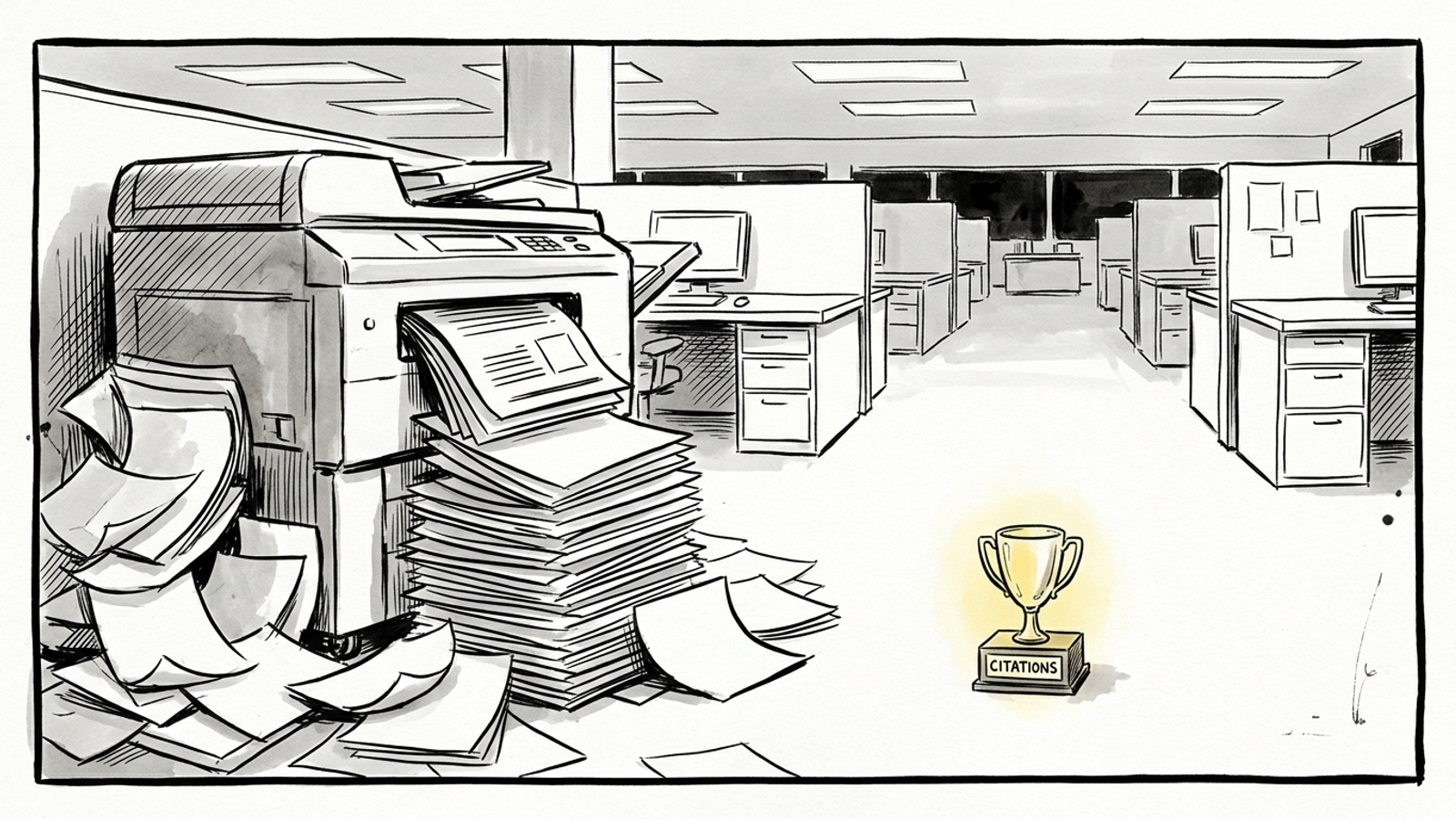
Upsell corner: more prompts, more opportunities
You asked what would happen if we monitored more prompts. We would find more gaps. The Visibility Momentum Index would have more activity to measure, and your team would have a longer list from which to choose. That is the advantage of expanded coverage: a question you did not know you were missing can become a question you know you are missing.
More coverage will not, by itself, rewrite the 212 pages already in your queue. It will not resolve the 96 technical flags or persuade a publication to mention you. Those tasks remain available to your team on every plan. We would hate for a plan upgrade to create the impression that we had quietly taken over your publishing calendar.
If budget is tight, you can stay with your current prompt set. The zero is sufficiently clear without additional sampling. If budget is available, we can make the report broader while you arrange the people who will act on it. Either way, we look forward to reporting what we find next month.
A note from your Customer Success Champion
Hi again, Sarah. I saw that you opened only 2 of our 11 insight emails, so I wanted to personally nudge this one to the top of your inbox. Your gap trend is one of the healthiest in my book. Many accounts stop producing fresh discoveries once the obvious questions are logged. Yours keeps giving us material for the next pulse check.
That suggests real opportunity ahead. It also suggests real work, which I have logged as an action item for you. If the list feels large, start with the 96 technical flags. A page the relevant crawlers cannot fetch is unlikely to benefit from an improved answer block. Once your team has investigated those flags, I can help you find the updated chart. I cannot make the server change from here.
I am available to explain any field in the dashboard, including the distinction between a gap and an opportunity. In most cases, the distinction is whether you are looking at the work from your side or mine. Let us keep the momentum going into April.
P.S. from someone who used to send Quality Score reports
I used to tell clients that a tidy Quality Score report was the work. I was wrong. I spent years mining negative keywords late at night for small ecommerce accounts, watching a score tank when a landing page changed without warning, then sending a neat PDF that explained the problem. Sometimes the explanation was useful. When it left the fixes sitting in somebody else’s queue, it was not a fix.
That experience is why I can describe your current arrangement so clearly. Detection is easy to repeat. Closure takes time on your site, on your server, and on other websites. Our software can tell you that a competitor supplied the answer ChatGPT used. It cannot turn your thin service page into a useful one by calling the observation an insight. Nor can another email from me earn the off-site mention you are missing.
Say you spend $20k a month on search and a buying question returns zero citations for two months while your recorded gaps rise from 812 to 847. You do not need a third month to establish that the dashboard works. You need to know who is changing the pages and checking whether those changes helped. If you are considering another dashboard, this open letter to the owner about to buy one has a question worth borrowing: who actually closes the gaps?
Your closure checklist, should you choose to use it
We have attached a practical checklist to help your team turn detected gaps into work. Complete it in order where a dependency matters; otherwise, assign each item to whoever can make the change. The dashboard will continue to display the gaps while you do this.
- Check crawler access first. Review
robots.txt, CDN rules, firewall rules, and server logs for GPTBot, OAI-SearchBot, ClaudeBot, and PerplexityBot; confirm that the relevant crawler fetched a live page. Use the technical AI visibility guide if a block needs fixing. Cost of skipping this: better copy may remain unread. - Put the answer near the top of each relevant page. Use a clear entity statement, a direct answer, and a dated fact in HTML a crawler can read; do not bury the answer beneath the introduction.
- Add LocalBusiness or FAQPage schema where it fits. Keep names, addresses, phone numbers, and hours consistent; mismatches make a business harder to identify.
- Earn mentions on sources the engines already cite. Prioritize credible publications, buying guides, and detailed review profiles over simply adding more posts to your own domain; earned media is a substantial source of AI citations.
- Correct wrong facts before publishing new ones. Update prices, hours, service areas, and product names wherever they appear, starting with your Google Business Profile; more repetition does not make a wrong price useful.
- Do not treat search rank as proof of a citation. AI citations and Google’s top results do not consistently overlap; improve the passage that answers the question rather than congratulating the rank tracker.
- Re-test the same 10 buying prompts after every change. Use the same wording and engines, then log the date, citation, and competitor mentioned. This is the item teams skip most: without it, you buy another report and cannot tell whether any fix changed the answer.
Your April renewal decision
Before renewing, put the dashboard fee beside the work it assigned. The 320 hours do not vanish because they arrived in a convenient interface. Someone still has to rewrite pages, investigate crawler blocks, correct conflicting details, and pursue mentions; paid placements are not a substitute for the earned coverage AI answers tend to cite. You can keep us for detection and arrange that work yourself. That is the service we sell.
Or you can pay for closure instead. This is where groas makes our renewal email awkward. Its SEO and AI Search Sprint is built around publishing pages, shipping technical fixes, building authority, and reporting where your business was named. Its autonomous engine handles ongoing execution while a named strategist owns direction and accountability. We offer you a better view of the queue. groas works on the queue.
I would prefer to discuss the Visibility Momentum Index, but the mechanism is harder to dress up. A page must be available to the relevant crawler, contain an answer worth using, and have facts that hold together across the places an engine may encounter your business. Credible off-site mentions give it more to draw from. Then someone has to re-test the question. None of those steps is accomplished by discovering the same gap again, however pleasing the new color on the chart.
So forward this email to whoever would do the 320 hours and ask whether they have time before the next pulse check. If the answer is silence, a wider prompt package will give that person a longer list, not more capacity. If you keep the tracker, hold it to the ten buying prompts in the checklist and look for citations after changes ship. I will still send April’s report. I would rather have something different to put in its first line.
Finding why you are not cited is the cheap half; paying someone to tell you again is not paying them to fix it.